

If you missed the signs of organizational stagnation, catch up on our previous edition, Blinded by the Smoke, to understand why moving from reactive firefighting to proactive alignment is critical.
Blinded by the Smoke
·
Jul 8

Too many nonprofits refuse to confront the uncomfortable. They cling to a “business as usual” approach until they are already choking on the smoke filling the room. The smoke they see usually looks like a precipitous decline in revenue. By the time they notice it, they are combating a lagging indicator rather than the root cause.
Marinate!
The Rapid Structured Study is complete. The organization has re-anchored to its purpose and compiled hard data across its finances, operations, and team dynamics. The standard executive reflex right now is immediate, reactive velocity—to leverage this fresh data and rush straight into developing a new strategic plan.
Don’t.
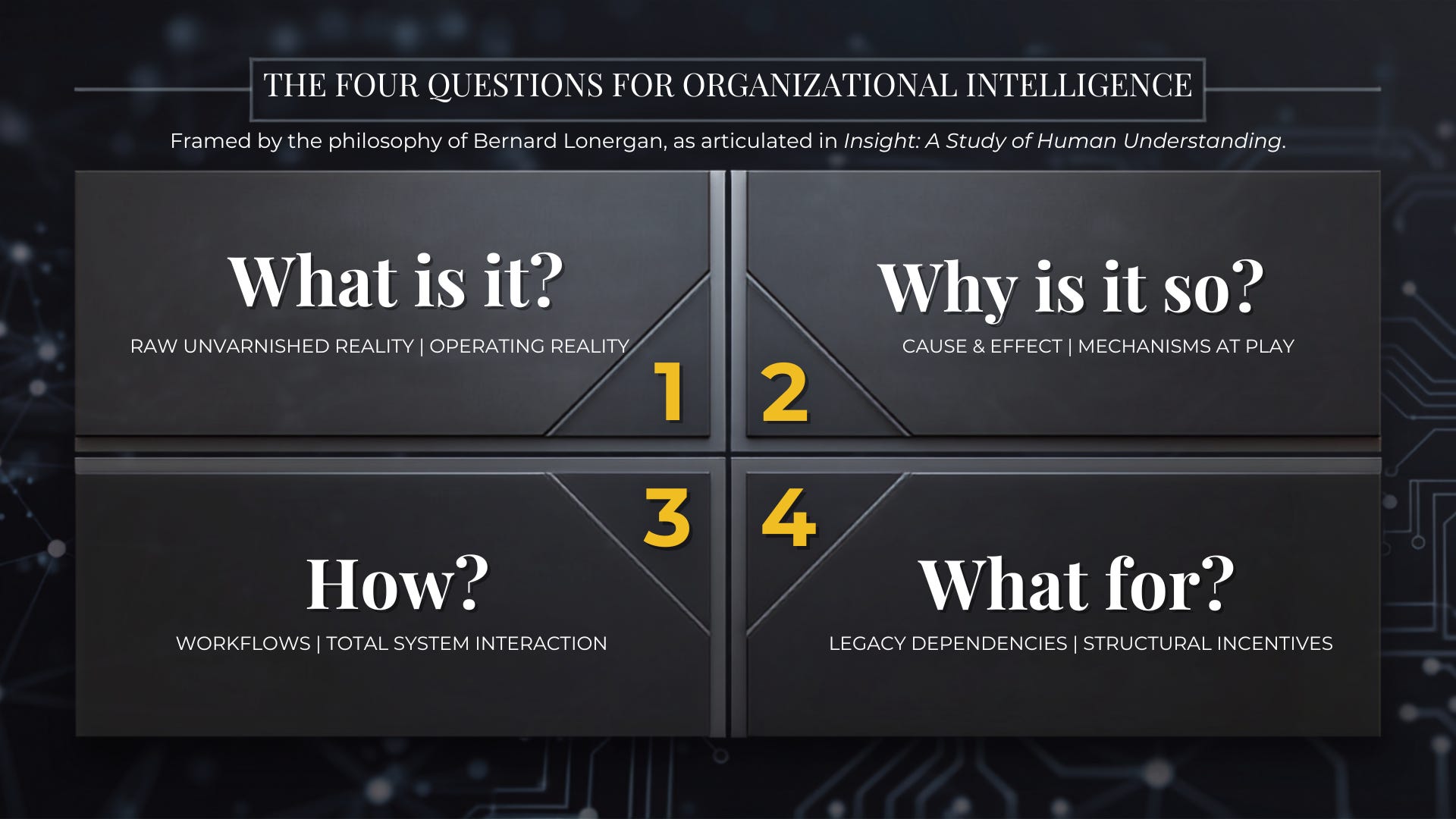
Teams must take a couple of weeks to step away from the whiteboard and let the evidence marinate. Before you are allowed to design a single new process, you need to force your leadership team to answer four clinical, diagnostic “Questions for Intelligence” formulated by philosopher Bernard Lonergan:
If you rush the time required to truly understand the data presented to you, my 30 years of experience as a CEO, executive director, President of the Board, and consultant tell me exactly what will happen: Your team will instinctively default to institutional inertia. You will replicate old playbooks, dress up old habits in new terminology, and simply redesign processes to work harder rather than smarter.
To understand the catastrophic cost of skipping this compulsory pause, we must look beyond theoretical frameworks and examine the cold, unvarnished analysis of the actual organizational challenges.
Join me on a journey following an actual multi-year structural and financial autopsy of a prominent $12M national advocacy organization—a system that chose the comfort of frantic planning over the discomfort of structural understanding, and allowed institutional inertia to quietly carry the day. I will dig into their public Form 990s and their publicly facing strategic plans to document and analyze the organization’s story.
Meditate.
Once an organization collects and organizes critical data on its financial outlook, internal operations, and its people, it must take time to reflect before jumping to conclusions or developing new plans. If they jump too early, they will be reactive rather than proactive. Most often, they default to a predictable playbook of panic: slashing essential staff, gutting operational capacity, and frantically squeezing legacy donors—working twice as hard to fund an engine that will not help them accomplish their true purpose.
Smoke
I know the taste of this smoke. I have breathed it in the boardroom, in government agencies, and at the helm of national nonprofits. In one case, I was a part of an organization experiencing a decline in revenue, overburdensome costs, and an inflection point in the organization’s purpose. Based on publicly facing 990 forms, I compiled the data below:

The table above shows a 13.43% decline in revenue in one year during a leadership transition and a 9.77% increase in expenses. All leaders would recognize this as a crisis. The question is how they will see themselves out of the crash.
Playbook of Panic
Unfortunately, this organization chose a playbook of panic and an illusion of alignment as its recovery methods. The organization slashed staff and organizational capacity rather than refocusing on its capacity to implement programs designed to provide direct support to patients..
The table below shows a gradual reduction of 71 staff members in Year A, at the height of their net assets and fund balances, to 57 employees in Year D. It is understandable for an organization, especially one with new leadership, to begin controlling costs, but it is important to see what organizational capacity was cut.
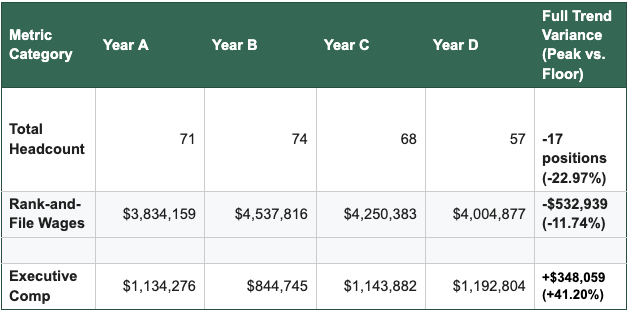
.The organization doubled down on its medical research staff and grant programs and outsourced its direct services to patients to its website and media campaigns. The organization’s leadership was able to right the ship financially. What remains to be seen is whether their efforts to rehabilitate the organization have only improved the balance sheet at the cost of their mission and vision.
Illusion of Alignment
Reviewing the organization’s current strategic plan reveals that its leaders have improved their publicly facing language. Their plan said that their organization was committed to “Optimizing Health for Everyone Now.” This sounds aligned with their true purpose, but I wonder if the organization’s research budget will have a demonstrable impact on finding a cure and improving the lives of those affected by the disease.
I fear that this organization jumped the gun and moved from the Study phase of the Pathway to Achievement, skipping over the Understand and Dream phases of the work. The result was to address budget shortfalls but overlook executing on their true purpose. By doing so, they risk “performing” interpretative dance beautifully while failing to achieve real improvements in the lives of those they serve.
Playbook for Renewal.
Grounding: Anchor to Your True Purpose.
To see what anchoring to purpose actually looks like while protecting the anonymity of the organization we just dissected, I will analyze another case study. It comes from an organization where I have direct experience, though I want to clarify that I did not consult on the specific segment of the 2022–2025 strategic plan cited below. I am sharing it purely for illustrative purposes.
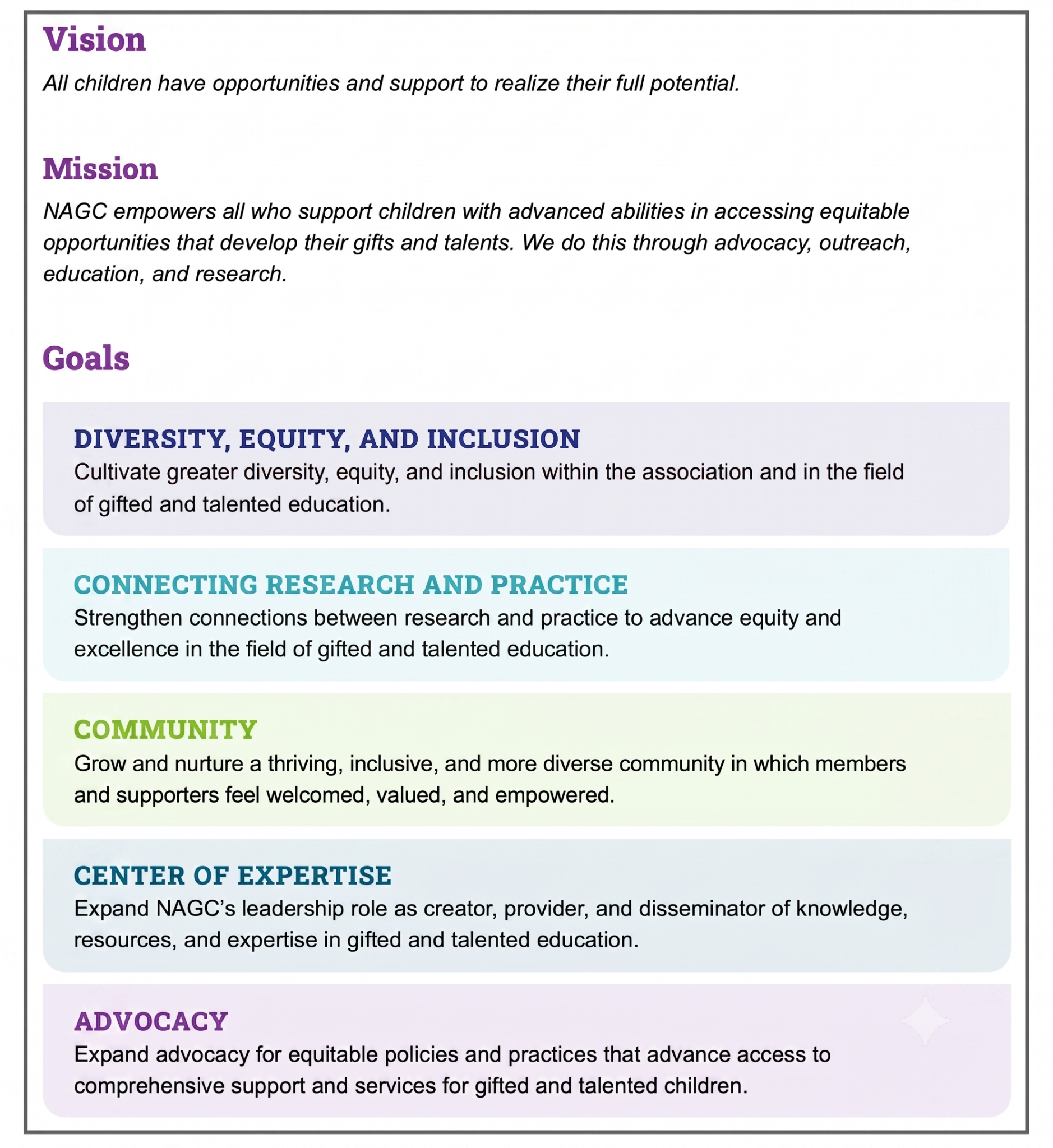
The vision statement is snappy, inspirational, and universally appealing: “All children have opportunities and support to realize their full potential.”
It is also strategically useless.
While noble and inclusive, this vision offers zero constraints. It leaves out the essential subject of the organization’s work: advanced learners.
A great vision statement is a North Star; it should illuminate the path and define the destination. If this association attempts to support the “full potential” of all 50 million K-12 students in the U.S., it will dilute its expertise, dissipate its funding, and fail the specific student population it exists to support.
Because the vision is too broad to guide difficult resource allocation and the behaviors of leadership, staff, members, and contractors, the burden of definition falls entirely on the mission statement. Thankfully, the mission clarifies the target: “children with advanced abilities.” They must clarify that they seek to optimize opportunities for children with advanced abilities—or a relevant variant—to force strategic alignment across their four pillars of advocacy, outreach, education, and research.

Questions for Reflection
The case study above illustrates the high cost of bypassing the “Marinate” phase in favor of the “Playbook of Panic.” To ensure your leadership team avoids this trap and doesn’t repeat the cycle of institutional inertia, you must resist the urge to rush into design. Instead, force a pause and rigorously answer these four clinical, diagnostic “Questions for Intelligence” formulated by philosopher Bernard Lonergan:
Reflect on the comprehensive data compiled in the study, and have the leadership team address the following questions. It is then important to share your findings with the broader staff to build urgency around sustainable improvement and prepare them for the next phase.
What is it? (What is the raw, unvarnished reality operating beneath your corporate labels?)
Why is it so? (What is the exact cause-and-effect mechanism in the organization?)
How? (How do individual tasks and day-to-day operational workflows interact in the total system?)
What for? (What hidden structural incentives or legacy dependencies is this current behavior protecting?)
Stop firefighting and start building organizational health. Grow your leadership skills and optimize your organizational architecture for maximum impact. Follow me on LinkedIn for daily data-based leadership insights, and subscribe to the Leader Lab on Substack for our full deep-dive editions delivered directly to your inbox.
You’ve stripped away the institutional noise and interrogated your reality—you have earned the right to design your future. In our next edition, we move from UNDERSTANDING to DREAMING the ideal future state.